Anchr raises $5.8M to bring AI-native automation to America’s food supply chain
4 mins ago
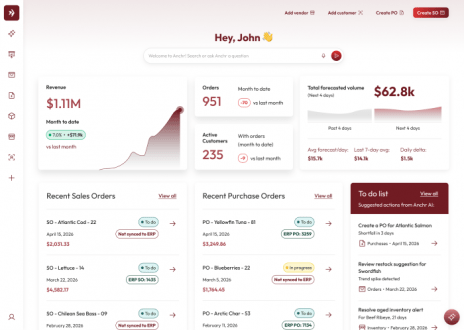
Anchr has raised $5.8 million in seed funding to build the first end-to-end, AI-native operating system for food distributors. The platform embeds cross-functional AI teammates across sales, purchasing, inventory, finance, and more eliminating manual bottlenecks in an industry operating on razor-thin margins.
Every restaurant order, grocery shelf, and catering delivery depends on a supply chain that still runs on text messages, spreadsheets, and systems designed decades ago. Food distributors move hundreds of billions of dollars in perishable inventory each year, yet much of the operational work that keeps product flowing remains manual. Anchr believes that is where AI should be applied next.
Today, the company announced a $5.8 million seed round backed by a16z Speedrun, Anterra Capital, Offline Ventures, Long Journey Ventures, and leaders from Open AI to build the first end-to-end AI-native operating system purpose-built for food distribution.
The gap is structural. Most distributors rely on ERP systems built to record what already happened, not to guide what should happen next. They log transactions but do not inform purchasing decisions, optimize inventory in real time, or surface margin risk before it materializes. eCommerce platforms such as Choco and Pepper digitize customer ordering but stop at the surface. They do not address purchasing, reconciliation, or margin intelligence, and in some cases intensify price competition in ways that disadvantage regional distributors. The result is a patchwork of tools that document activity without holistic context, adding to the operational complexity rather than alleviating it.
Anchr sits on top of the existing stack and turns it into a system of action. Rather than replacing the ERP, it embeds AI teammates across order intake, purchasing, inventory planning, invoicing, collections, and more. Workflows that previously required hours of manual intervention now execute automatically, with full context carried from one step to the next.
“The biggest opportunity to leverage AI isn’t in industries with modern infrastructure,” said Tzar Taraporvala, Co-Founder and Co-CEO of Anchr. “It’s buried deep in the operational backbone of the economy. Food distributors manage millions of dollars of inventory with systems that were never designed to handle today’s complexity. We built Anchr to become the intelligent layer that works alongside teams every single day, automating away the tedious, unsexy parts of the job to create truly material value for a margin-strapped business.”
The company was born inside the problem it aims to solve. Co-Founders Tzar Taraporvala and Smayan Mehra, who have been building together for more than two decades, began exploring supply chain inefficiencies after seeing how disconnected legacy infrastructure remained. The turning point came when they partnered with a Boston-based seafood distributor, and spent months mapping workflows on the factory floor. Orders were manually keyed into ERPs at 3 a.m. Purchasing decisions relied on fragmented spreadsheets. Finance teams reconciled invoices across disconnected systems. The pain was structural, daily, and expensive.
Today, Anchr’s impact shows up in measurable ways. One early customer reclaimed roughly 40 percent of daily working time across a team of eight sales representatives by automating order intake from texts and emails. Another distributor reduced aged inventory write-offs by $30,000 in one month through improved purchasing decisions informed by live demand signals. A customer is on track to increase average basket size by approximately $65 per order across 4,000 annual orders by using AI to scrape menus and catalogues to surface upsell opportunities. In a business operating on low single-digit margins, incremental gains compound quickly.
The traction reflects that urgency. In just 12 weeks of Speedrun, Anchr booked seven figures in revenue, with customers ranging from regional distributors to a $5 billion publicly traded enterprise.
“If the first era of enterprise software digitized record-keeping, we believe the next era will automate it. We call that shift Enterprise Resource Automation (ERA) – and Anchr is building this inevitable operating layer” concludes Smayan Mehra, Co-Founder and Co-CEO, Anchr.
Looking ahead, Anchr plans to deepen automation across every operational layer of a distributor, becoming the coordination system that touches every decision that moves product or capital. Over time, this creates the foundation for an AI-native system of record built on the real work that happens in these organizations. Beyond food, the company sees the same opportunity anywhere physical goods move through fragmented supply chains.
“The magic here is compounding: when sales, purchasing, inventory, and finance share context, the whole business runs differently. Anchr is building an AI-native operating layer that turns fragmented steps into an integrated workflow and the early customer outcomes show what that unlocks,” said Troy Kirwin at a16z Speedrun