When the highest safety requirements demand purpose-built vehicle solutions
44 mins ago
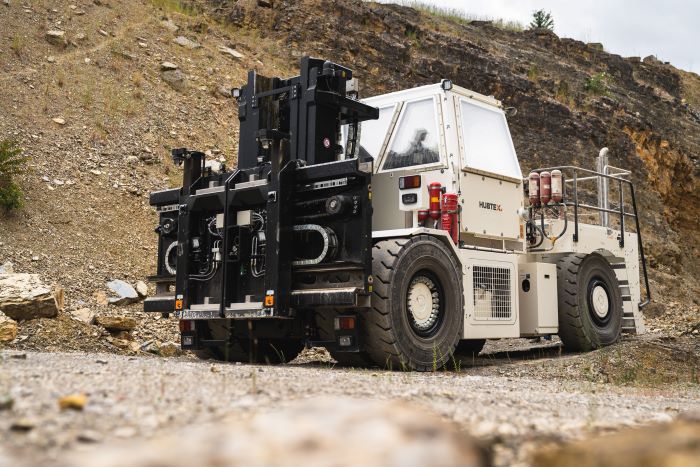
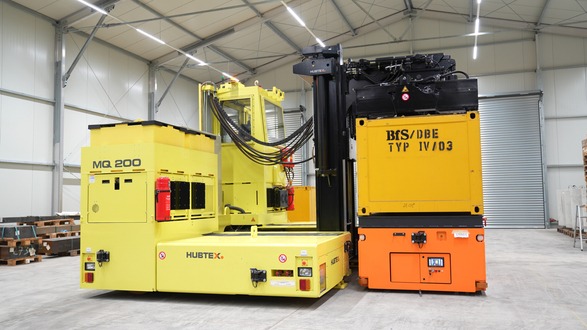
For the German Konrad repository, HUBTEX has developed a coordinated fleet of five specialised vehicle types. Several of the larger vehicles will now be disassembled into individual components, brought into the underground facility and reassembled there. During this process the existing inspection and documentation chain must be continued seamlessly.
The vehicles are part of the future storage process of the Federal Company for Radioactive Waste Disposal (BGE). They perform coordinated tasks ranging from above-ground handling and onward transport to the precise positioning of low- and intermediate-level radioactive waste at a depth of around 850 metres. They will transport fresh concrete and concrete delivered by pump for the subsequent backfilling of the storage areas. The decisive factor is not an individual vehicle but rather the safe interaction of all vehicle types at defined transfer points.
From process to vehicle architecture
No suitable standard solution was available for this application. Narrow travel routes, gradients, high vehicle weights, as well as clearly defined driving, braking and transfer processes determine the design. Added to this are stringent requirements relating to radiation protection, decontamination, fire-load requirements, collision avoidance, potential fall heights and operator protection. Every transport operation must remain controllable, reliable and traceable.
HUBTEX therefore first analysed the travel routes, interfaces, load transfers, environmental conditions and potential hazards. This resulted in new, coordinated chassis, steering, lifting and protection concepts. Depending on their specific task, the vehicles are equipped with features including shielded, radiation-protected driver cabins featuring lead glass and solid steel walls, protected ventilation systems, fire monitoring, fire-extinguishing systems and emergency steering systems. Position detection, optical track guidance, load-unit tracking and communication systems support controlled integration into the overall process.
“The greatest challenge lies not in any individual vehicle, but in the interaction of all functions and interfaces. Mechanics, protection systems, transfers and process monitoring had to be conceived as an integrated overall system from the outset. At the same time, every technical step must still be clearly traceable even many years later,” says Frank Knurr, Sales and Project Engineer for the BGE project at HUBTEX.
Safety must be demonstrable
The development work therefore encompasses far more than construction. Drawings, calculations and inspection plans specify how the vehicles have to be designed, manufactured and tested. Technical changes are assessed, documented and only implemented following approval. The final documentation reflects not only the planned condition, but also the condition actually manufactured and tested.
Quality assurance in production is also not merely a final inspection step. Materials, welded joints, assemblies and installations are inspected during manufacturing in accordance with defined inspection plans. Depending on the inspection step, representatives of BGE and an independent expert are involved alongside HUBTEX Quality Assurance. Additional welding and procedure qualifications, as well as non-destructive testing methods, ensure the integrity of specialised materials, sheet thicknesses and joining techniques.
The project demonstrates how HUBTEX translates highly specialised material-flow requirements into individually developed and fully documented special-purpose vehicle solutions. This expertise is relevant wherever heavy, sensitive or hazardous loads need to be moved along restricted travel routes and under demanding environmental conditions, with stringent requirements for safety, process reliability and verification.